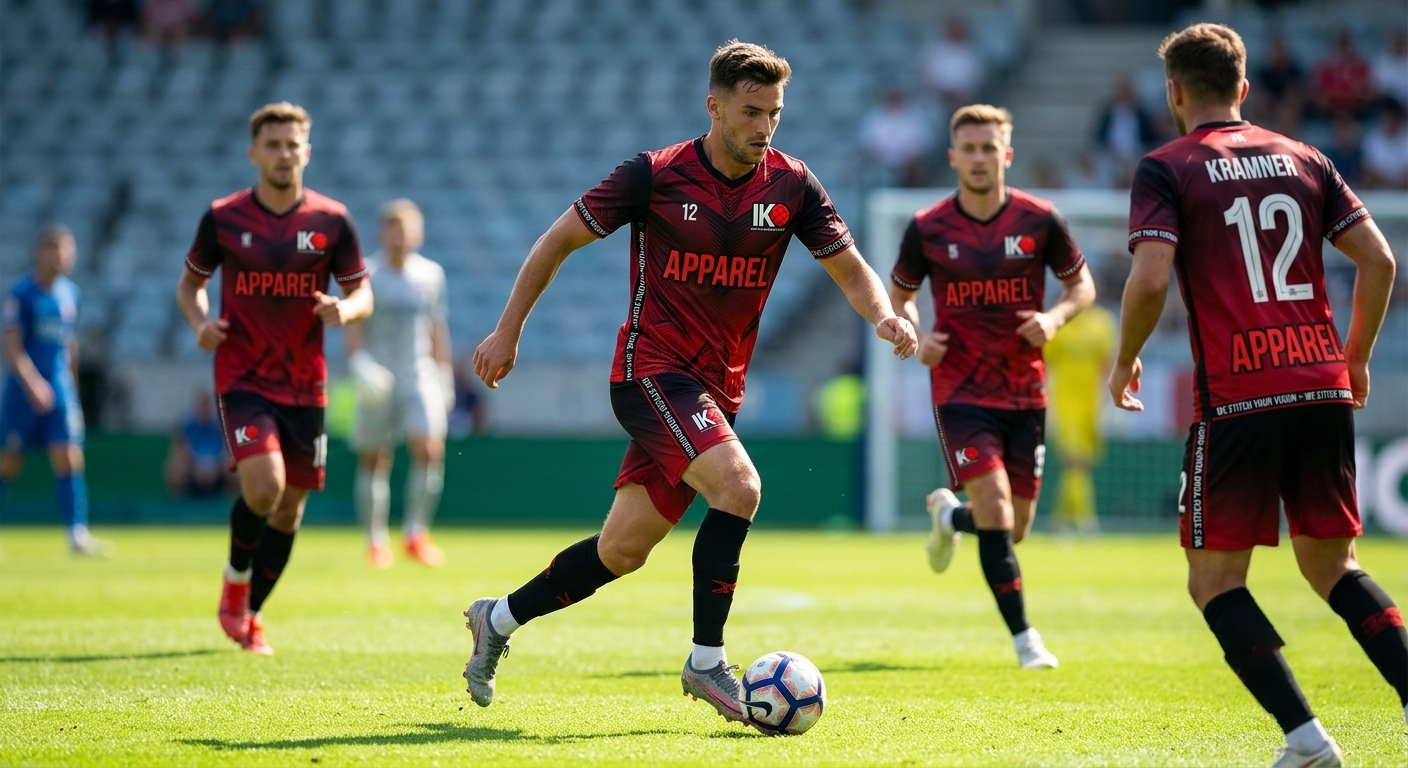
If you have ever held a custom sports jersey and noticed that the colors look like they are part of the fabric not sitting on top of it that is sublimation printing at work. This technique has become one of the most preferred methods for producing high-quality, durable, and vibrant custom sportswear across the USA. Whether you are outfitting a youth soccer league in Texas or building a performance apparel brand in California, understanding sublimation printing helps you make smarter decisions about your uniforms and activewear.
This guide breaks down the science behind dye-sublimation, explains which fabrics work best, and shows you exactly why this process is trusted by top sportswear manufacturers including IKApparel, a globally recognized name in custom performance wear.
What Is Sublimation Printing?
Sublimation printing, also called dye-sublimation printing, is a heat-activated printing process where special dyes are converted from a solid state directly into a gas without passing through a liquid phase. That gas then bonds permanently with synthetic fibers, most commonly polyester, at the molecular level.
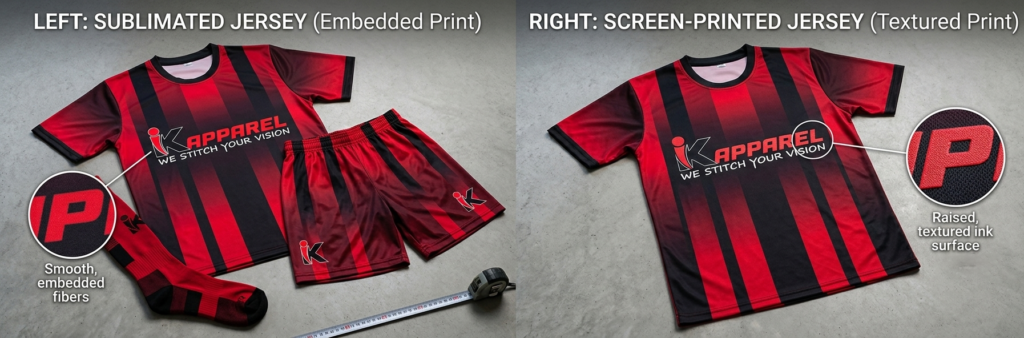
The result is a print that does not sit on the surface of the fabric. Instead, the color becomes part of the fiber itself. This is why sublimated garments feel soft to the touch, even in heavily printed areas. There is no texture, no cracking, and no peeling which makes it fundamentally different from screen printing or heat transfer methods.
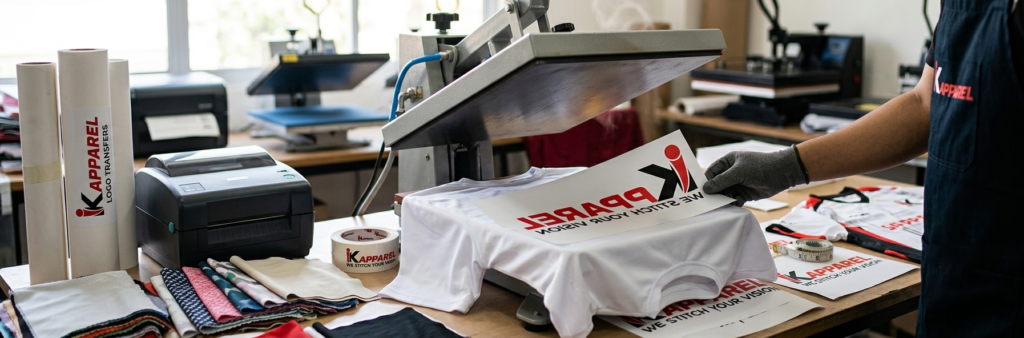
This process works through a combination of heat and pressure. A sublimation printer first prints the design onto a special transfer paper using sublimation inks. That paper is then placed against the fabric and pressed in a heat press at around 375 to 400 degrees Fahrenheit. The high heat causes the ink to vaporize, and the pressure forces the gas into the open pores of the polyester fiber. When the fabric cools, the pores close and the dye is permanently locked inside.
IKApparel uses this exact process across its team sportswear production lines to deliver consistent, competition-ready uniforms that hold up through heavy use, repeated washing, and outdoor conditions.
Why Sublimation Printing Matters for Sportswear
In the USA, sports culture is serious. From high school varsity teams to amateur leagues to professional organizations, the demand for performance apparel that looks sharp and performs well is constant. Sublimation printing directly addresses both needs.
Traditional printing methods often struggle with activewear. Plastisol screen printing can crack under repeated stretching. Iron-on transfers may peel after a season of play. Embroidery adds weight and can affect breathability in performance garments. Sublimation avoids all of these issues because the dye integrates with the fabric structure itself.
For coaches, team managers, and athletic directors ordering custom uniforms across American sports programs, sublimation also offers complete design freedom. You are not limited to spot colors or basic logo placements. Full photographic gradients, intricate patterns, team colors, numbers, names, and sponsor logos can all be included in one seamless print with zero additional cost per color.
This is why IKApparel’s sublimation printing service is widely used for everything from soccer uniforms and basketball jerseys to cycling kits and eSports apparel across both youth leagues and adult programs throughout the USA.
The Science of Dye-Sublimation: How It Works Step by Step
Understanding how sublimation printing actually functions helps you appreciate why fabric choice matters so much.
Step one is design preparation. The artwork is created digitally and mirrored before printing, because the design is transferred in reverse.
Step two is ink printing. The mirrored design is printed onto sublimation transfer paper using specialized sublimation inks. These inks are chemically formulated to vaporize at specific heat thresholds.
Step three is the heat transfer process. The transfer paper is placed ink-side down against the fabric. A commercial heat press applies consistent pressure at approximately 380 to 400 degrees Fahrenheit for 45 to 60 seconds.
Step four is dye bonding. At that temperature, the ink converts to gas and penetrates the polyester fibers. The dye chemically bonds with the polymer chains inside the fabric.
Step five is cooling. The fabric cools, the fibers contract, and the dye is permanently locked in. The transfer paper is removed, leaving behind a vibrant, fully integrated design.
This is a one-way process. Once the dye bonds with the fiber, it cannot be washed out, peeled off, or rubbed away under normal conditions. The print essentially becomes the fabric.
Best Fabrics for Sublimation Printing
This is where many brands and buyers make costly mistakes. Sublimation printing only works properly on specific fabric types. Using the wrong material leads to washed-out colors, uneven prints, and designs that fade quickly.
The following table outlines the most common fabric types used in USA sportswear and their sublimation compatibility.
FABRIC COMPATIBILITY TABLE FOR SUBLIMATION PRINTING
| Fabric Type | Polyester Content | Sublimation Result | Best Use |
|---|---|---|---|
| 100% Polyester | 100% | Excellent — vivid, sharp, permanent | Jerseys, cycling kits, performance tees |
| Polyester-Spandex Blend | 88-92% poly | Very Good — slight stretch, still vibrant | Compression wear, leggings, sports bras |
| Polyester-Nylon Blend | 80%+ poly | Good — works well for athletic shorts | Running shorts, swim shorts |
| Cotton-Poly Blend | 50-65% poly | Poor — faded, washed-out result | Not recommended for sublimation |
| 100% Cotton | 0% poly | Does not work | Incompatible fabric |
| Dri-Fit / Moisture Wicking Poly | 100% poly | Excellent | Performance activewear, team uniforms |
The key rule is this: the higher the polyester percentage, the better the sublimation result. For competition-level sportswear, IKApparel recommends 100% polyester or at minimum a 92% polyester blend to ensure color accuracy, brightness, and wash durability.
White or light-colored base fabrics also produce the most accurate colors. Since sublimation dyes are transparent, printing on a dark base fabric will cause the colors to appear muted or distorted. For dark-base designs, alternative methods like direct-to-film printing may be more appropriate. You can learn more about that option through IKApparel’s Direct To Film DTF Printing service.
Key Benefits of Sublimation Printing for Performance Apparel
Sublimation printing offers a specific set of advantages that make it particularly well-suited for athletic and sportswear applications in the USA.
Prints are completely breathable. Because the dye becomes part of the fiber rather than a coating on top, airflow through the fabric is not restricted. This matters significantly in performance wear where moisture wicking and ventilation are essential.
Colors remain vivid after repeated washing. Unlike screen prints that gradually crack or fade, sublimated prints maintain their brightness even after dozens of high-temperature washes. This makes sublimated uniforms far more cost-effective over the life of the garment.
There is no minimum color cost. Whether your design uses two colors or twenty, the production cost per unit remains the same. This gives designers and sports teams in the USA complete creative freedom without financial penalty.
Prints are lightweight and soft to the touch. There is no ink sitting on the surface, so the garment retains its original hand feel. Athletes wearing sublimated jerseys do not feel any added weight or stiffness from the print.
Full-body designs are possible. Sublimation allows edge-to-edge coverage, meaning designs can wrap fully around the garment including seams and panels. For Sublimation Printing on team uniforms, this makes it possible to create truly custom, one-of-a-kind designs that stand out on the field.
Performance Wear Applications in the USA
Sublimation printing is used across nearly every major sport and athletic category in the United States. The versatility of the process makes it a standard in both amateur and professional team uniform production.
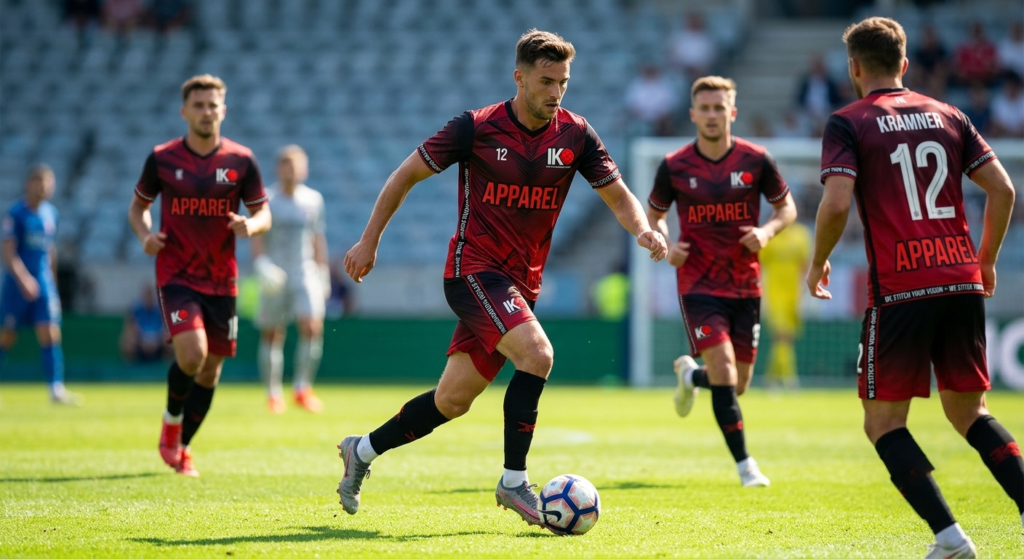
Soccer programs across American high schools, colleges, and club leagues rely on sublimated jerseys for their lightweight feel and full-color customization. The ability to print names, numbers, sponsor logos, and team crests in one pass makes the process highly efficient.
Basketball teams benefit from sublimation because the process works seamlessly on the sleeveless, stretch-heavy cut of basketball uniforms. Basketball Uniforms and Jerseys printed through sublimation hold their color through a full season of play without any degradation.
Cycling apparel including full race kits with gradient designs and aerodynamic panel patterns is almost exclusively produced through sublimation. The combination of spandex-poly fabric and full-coverage sublimated printing is the industry standard for cycling teams across the USA.
eSports is a growing category in America. Organizations producing branded jerseys for gaming tournaments increasingly use sublimation for its ability to reproduce complex digital graphics with precision. E Sports Jerseys produced through sublimation look as sharp in person as they do on screen.
IKApparel also produces sublimated cricket uniforms, volleyball kits, badminton apparel, and referee uniforms serving both domestic American leagues and international teams ordering from the USA.
Common Mistakes to Avoid With Sublimation Printing
Several mistakes consistently affect the quality of sublimated sportswear especially when ordering for USA teams and brands for the first time.
Choosing the wrong fabric is the most frequent error. Buyers sometimes select cotton-poly blends for cost reasons, not realizing that the cotton content will produce faded and uneven results. Always confirm fabric content before placing a sublimation order.
Using dark base colors without adjusting the design approach is another common problem. Sublimation dyes are transparent, so they cannot override dark fabric. If your design requires dark garments, discuss options with your manufacturer before committing to sublimation.
Submitting low-resolution artwork causes blurry or pixelated prints. Because sublimation can reproduce incredibly fine detail, it also reveals every flaw in a design file. Always provide artwork at 150 to 300 DPI at print size. IKApparel’s Design Review and Repair service can help prepare files properly before production.
Expecting sublimation to work on finished garments with existing seams and thick hems may produce inconsistent pressure during the heat press step. Cut-and-sew sublimation where panels are printed before construction produces the cleanest results.
Ignoring color profiles is another issue. Sublimation inks print in CMYK, and colors on screen in RGB may appear different once printed. Always request a printed sample or proof before approving a full run.
Sublimation vs. Other Printing Methods: Quick Comparison
Understanding how sublimation stacks up against other popular printing techniques helps you choose the right process for each project.
SUBLIMATION VS OTHER PRINTING METHODS
| Feature | Sublimation | Screen Printing | DTF Printing | All-Over Printing |
|---|---|---|---|---|
| Fabric Requirement | Polyester only | Works on cotton | Works on most fabrics | Primarily polyester |
| Color Limitation | None — full color | Per-color cost | None | None |
| Print Feel | Soft, embedded | Slightly raised | Smooth film layer | Soft, embedded |
| Wash Durability | Very high | Moderate | High | High |
| Best For | Sportswear, jerseys | T-shirts, hoodies | Mixed-fabric apparel | Fashion, streetwear |
| Dark Fabric Compatible | No | Yes | Yes | Limited |
| All-Over Coverage | Yes | Limited | Yes | Yes |
If your project involves cotton-heavy garments or dark base fabrics, Screen Printing or DTF may be better fits. IKApparel offers a full range of decoration options so you can choose the right method for each garment.
Best Practices for Sublimation Sportswear Production
Working with an experienced manufacturer like IKApparel and following these production practices will consistently deliver the best results.
Always use 100% polyester or a minimum 92% polyester blend fabric for any garment intended for sublimation. Confirm this with your fabric supplier or manufacturer before the order is finalized.
Design with color profiles in mind. Use sRGB color mode during the design process and communicate to your printer which color values are priorities. Request a strike-off or sample garment before committing to a full production run.
For team orders, standardize the name and number layout in a single design file. Sublimation personalization is most efficient when all customization variables are pre-mapped in the artwork. IKApparel’s Team Personalization service is structured specifically for this type of order.
Consider cut-and-sew construction for premium uniforms. This means panels are sublimated before being sewn together, which allows for seamless design continuity across the entire garment, including across seams. For high-performance sportswear, the difference in finish quality is visible.
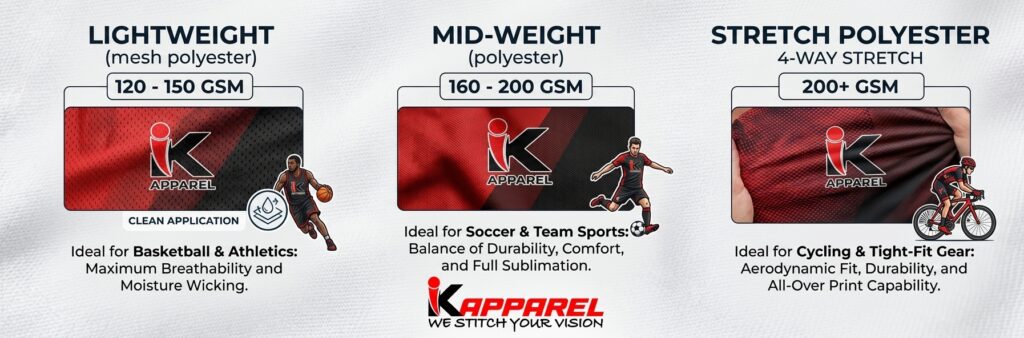
Request GSM-appropriate fabric for your specific sport. Cycling jerseys, for example, require lightweight polyester fabrics in the 120 to 140 GSM range. Basketball jerseys typically use breathable mesh polyester. Knowing your application helps select the right fabric weight for sublimation.
How to Choose a Sublimation Printing Partner in the US
Not every manufacturer produces sublimation sportswear at the same quality level. Choosing the right partner makes a measurable difference in the final product.
Look for manufacturers with dedicated sublimation printing equipment not shared or general-purpose heat presses. The quality of the machine directly affects color consistency and print sharpness.
Evaluate sample quality before placing large orders. Request physical samples in your team colors and review color accuracy, print sharpness at edges, and fabric softness.
Confirm turnaround times and production capacity. USA-based sports programs often operate on tight schedules for league deadlines. Ask specifically about lead times for your order size.
Check whether the manufacturer offers design support. IKApparel’s design and review service helps clients prepare artwork that is optimized for sublimation from the start, reducing revision cycles and production delays.
Consider full-service vendors who can handle fabric sourcing, cut-and-sew construction, printing, and finishing under one roof. This reduces coordination complexity and quality risks across multiple vendors.
IKApparel operates as a vertically integrated custom sportswear manufacturer, serving teams, brands, and retailers across the USA with end-to-end production capabilities from fabric sourcing to final packaging.
Frequently Asked Questions About Sublimation Printing
What fabrics can be used for sublimation printing?
Sublimation printing works best on 100% polyester and high-polyester blend fabrics. Polyester-spandex blends with at least 88% polyester content also produce excellent results. Cotton does not work with sublimation because the dye cannot bond with natural fibers. Always confirm the polyester percentage of your fabric before ordering sublimated sportswear.
Can sublimation printing be done on dark-colored fabric?
Standard sublimation printing is not suitable for dark base fabrics because sublimation dyes are transparent they cannot override the base color. White and light-colored polyester fabrics produce the most accurate and vibrant results. For designs on dark garments, direct-to-film or screen printing methods are better alternatives.
How long do sublimation prints last on sportswear?
Sublimation prints are highly durable and are designed to last the life of the garment. Because the dye bonds permanently with the polyester fiber, the print will not crack, peel, or significantly fade under normal washing conditions. Most sublimated sportswear maintains its original vibrancy for years with proper care.
What is the minimum order quantity for sublimated uniforms?
Minimum order quantities vary by manufacturer. IKApparel works with teams and brands across the USA and can accommodate both small team orders and large bulk production runs. Contacting the team directly with your specific requirements is the best way to confirm quantities and pricing.
Is sublimation printing more expensive than screen printing?
For simple, low-color designs, screen printing may cost less per unit. However, sublimation becomes more cost-effective when designs include multiple colors, gradients, or full-coverage patterns because there is no per-color charge. For custom team uniforms with full branding, numbers, and names, sublimation often delivers better value overall.
Final Thoughts
Sublimation printing is one of the most reliable and effective methods available for producing custom sportswear in the USA. It delivers vibrant, durable, full-coverage prints that perform as well as the athletes wearing them. The key is understanding that this process is closely tied to fabric choice polyester is essential and that results depend heavily on design preparation and production expertise.
Whether you are ordering team jerseys for the upcoming season, launching an activewear brand, or producing uniforms for a multi-sport program, IKApparel has the equipment, expertise, and production capacity to bring your designs to life through professional sublimation printing. Reach out to the IKApparel team to discuss your project requirements and request samples before you commit to a full order.
Logo and Sports is a premier custom made sports wear manufacturers company in Sialkot Pakistan, dedicated to providing high-performance apparel solutions for global brands. We specialize in a diverse range of high-quality products, including trend-setting fashion wear, versatile athleisure, and performance-driven active wear. Our expertise extends to manufacturing premium fitness wear and durable team wear for men and women, ensuring every garment delivers a perfect blend of comfort, style, and athletic excellence.