
Why Minimum Order Quantities Are the First Wall Every Startup Brand Hits
Starting a clothing brand in the USA is exciting. You have the designs, the vision, and maybe even a few pre-orders lined up. Then you reach out to a factory and hit the first major obstacle: the minimum order quantity, or MOQ.
Factories ask for 100, 200, sometimes 500 pieces per style. For a startup working with limited capital, that number can feel impossible. But here is the truth: MOQ is not a wall. It is a starting point for a conversation.
This guide breaks down what MOQ really means, why factories set it, and how startup brands across the USA can negotiate smaller test batches without burning bridges or losing credibility with suppliers.
What Is MOQ and Why Do Factories Use It
MOQ stands for minimum order quantity apparel USA. It is the lowest number of units a factory will produce in a single order. This number varies depending on the factory, the product type, the decoration method, and the complexity of the garment.
A factory that produces custom hoodies might set an MOQ of 50 to 100 pieces per color or design. A cut-and-sew manufacturer producing fully custom garments might require 200 to 500 pieces per style. Screen printers often set MOQs around 24 to 48 pieces depending on the number of ink colors.
The reason factories set MOQs comes down to simple economics. Every production run has fixed costs that do not change based on how many units are made. Setting up screens for screen printing, preparing embroidery files, sourcing specific fabrics, cutting patterns, and running quality control checks all take time and money. If a factory produces only 10 pieces, those fixed costs make each unit incredibly expensive to produce. The factory either loses money or has to charge prices no brand would accept.
MOQ protects the factory’s margins while keeping their production line efficient.
The Real Cost Behind Every Factory MOQ
To negotiate effectively, you need to understand what drives the MOQ from the factory’s perspective.
Setup Costs
Every decoration or production method has a setup phase. For screen printing, this means creating screens one for each ink color. For embroidery, this means digitizing the design and programming the machine. These costs are fixed regardless of how many pieces are ordered. A factory absorbs those costs more easily when the order volume is higher.
Material Minimums
Fabric mills and material suppliers have their own minimums. When a factory orders fabric in a specific color, weight, or blend, they often need to commit to a minimum yardage. If your order doesn’t justify that fabric purchase, the factory either declines or passes the excess cost to you.
Labor Efficiency
Production lines are set up for efficiency. Switching between small jobs throughout the day is time-consuming. Larger runs allow workers to move faster, reduce error rates, and complete more units per hour. Smaller orders disrupt that rhythm.
Profit Margin per Unit
On smaller orders, the per-unit profit for a factory is lower because overhead is spread across fewer units. To stay profitable, factories either raise per-unit prices or set MOQs high enough to keep their margins intact.
Key Differences in MOQ by Product Type USA Market Reference Table
| Product Type | Typical MOQ (USA Market) | Notes |
|---|---|---|
| Blank T-Shirts (stock) | 1–12 pieces | No customization, stock items |
| Screen Printed T-Shirts | 24–72 pieces per design | Varies by number of colors |
| Embroidered Hoodies | 12–50 pieces | Lower if simple logo |
| Custom Cut & Sew Garments | 100–500 pieces per style | Higher due to full production setup |
| Private Label Clothing | 50–200 pieces per style | Depends on label and finishing requirements |
| Sublimation Printed Apparel | 12–50 pieces | Lower MOQ due to no screen setup |
| DTG Printed Garments | 1–24 pieces | Very low MOQ, no setup cost |
| Varsity or Letterman Jackets | 24–100 pieces | Higher due to complexity |
This table gives startup brands a realistic baseline before approaching factories. Knowing the typical range means you walk in with reasonable expectations instead of getting caught off guard.
How to Negotiate a Lower MOQ Without Sounding Like an Amateur
Negotiating MOQ is a skill. Factories receive hundreds of inquiries every month. The brands that get favorable terms are the ones that communicate professionally and give the factory a reason to say yes.
Here are the strategies that actually work for USA-based startup brands.
Start With a Relationship, Not Just a Request
Cold emails asking for 25 pieces at the lowest price possible almost always get ignored. Instead, introduce yourself properly. Explain who you are, what your brand is about, and where you see it going. Factories want long-term customers, not one-time buyers. If you can show them you plan to scale, they are far more likely to work with your initial small numbers.
Be Transparent About Your Stage
Tell the factory you are in the early stage and testing your market. Most factory owners and sales reps respect honesty. If you pretend to be a large brand and order 300 pieces only to disappear, that damages trust. If you say you are starting small but plan to grow, that opens a real conversation.
Offer a Higher Unit Price in Exchange for a Lower MOQ
This is one of the most effective tactics. If the factory quotes you $15 per unit at 100 pieces, ask whether they can do 30 pieces at $20 per unit. You are paying more per unit, but your total spend is lower, and your risk is reduced. The factory still covers their fixed costs and often makes comparable margin.
Consolidate Your SKUs low minimum order quantity clothing factory
Instead of ordering five different colors of one design, consolidate your first order. Pick two colors or one design and hit the MOQ on that single run. Once you prove the product sells, expand from there.
Order a Sample Run or Pre-Production Sample
Many factories are willing to produce a small sample run of five to ten pieces at a higher per-unit cost. This gives you a finished product to photograph, show to customers, and validate demand before committing to a larger run.
Commit to a Future Order in Writing
Offer the factory a letter of intent or a commitment that if the test batch sells, you will place a larger order within 60 to 90 days. This does not need to be a legally binding contract it shows good faith and gives the factory confidence in your long-term value.
What Decoration Method You Choose Affects MOQ Significantly
Your decoration choice has a direct impact on how high the MOQ will be. Choosing the right method for your budget and order size can cut your MOQ dramatically.
Direct to Garment printing, or DTG, is one of the most flexible options for small orders. Because there is no screen setup, factories can print as few as one piece at a time. If you are testing a graphic tee design, DTG is a practical starting point. You can explore DTG printed garments to see how the method works for different apparel styles.
Direct to Film, or DTF printing, also offers lower MOQs because it eliminates the screen setup cost. It works on a wide range of fabrics and produces vibrant, detailed results.
Screen printing typically requires higher MOQs because of setup costs per ink color. However, it is still one of the most cost-effective methods once you reach the minimum. If your design uses only one or two colors, screen printing MOQs become more manageable.
Embroidery has relatively low MOQs for simple designs, sometimes as few as 12 to 24 pieces, making it a strong option for branded caps, polos, or jackets. The key is keeping the stitch count manageable so the setup fee does not become prohibitive.
For fully custom garments with cut-and-sew customization, MOQs will naturally be higher due to the pattern-making, fabric sourcing, and construction involved. This method is best approached once you have validated your product concept.
Private label clothing programs often have flexible MOQs because the factories running them specialize in small-batch brand launches. If you are building a brand with custom labels and retail packaging, working with a supplier that offers private label clothing services gives you more room to negotiate startup-friendly quantities.
MOQ Negotiation: What to Say and What to Avoid
Say This:
“We are a startup brand based in the USA and are currently in our test phase. We plan to scale significantly over the next year and are looking for a long-term manufacturing partner. Can we discuss a reduced first-order quantity at an adjusted price per unit?”
Avoid This:
“Can you do 20 pieces? We don’t have much budget right now.” This signals low commitment and gives the factory no reason to prioritize your account.
Also avoid comparing one factory's pricing openly to another while negotiating. It creates friction and rarely helps.
USA Brands That Start Small and Scale Smart
Many successful USA streetwear and lifestyle brands started with test batches well below factory MOQs. They used strategies like pre-orders, crowdfunding, and pop-up events to validate demand before committing to larger production runs.
The pattern is consistent: start with the lowest viable quantity, validate the design and market response, then scale into larger orders with the confidence of real sales data behind you.
Brands that chase low per-unit costs by over-ordering early often sit on unsold inventory that eats their working capital. Starting small is not a weakness; it is a financially sound approach to brand building.
If you are building a UK-based apparel brand, consider your first order a learning experience more than a profit center. The goal is to understand your customer, test your designs, and build a supplier relationship that will support your growth.
Common Mistakes USA Startup Brands Make Around MOQ
Accepting the first MOQ without negotiating
Most factories have flexibility. The first number they give you is rarely the final number. Ask the question.
Ordering too many products at once
Startup brands often try to launch with five to ten styles. Consolidate. Master one or two products first and scale from there.
Ignoring the decoration method’s impact
Choosing screen printing when your quantity is 30 pieces will either push you above budget or get you rejected. Match your decoration method to your order size.
Not asking about sample production options
Many factories offer pre-production samples or development samples. These give you a finished product to test without committing to a full MOQ.
Focusing only on price, not relationship
The cheapest factory is rarely the best partner. A factory that communicates well, delivers on time, and works with your growth stage is worth more than a slightly lower unit cost.
Working With IKApparel: Low MOQ Solutions for USA Startup Brands
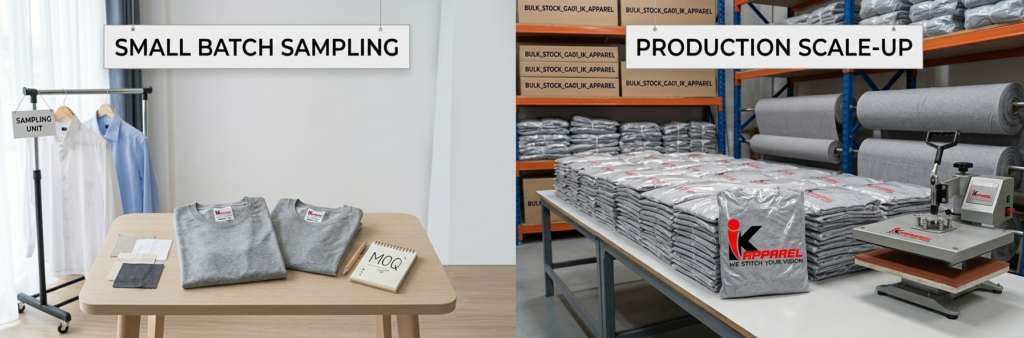
IKApparel is a globally recognized apparel manufacturing brand that works with startup clothing labels, established brands, and everything in between. For USA-based founders navigating the MOQ challenge, IKApparel offers flexible production options across a wide range of garment types and customization methods.
Whether you are looking for small batch screen printing, embroidered hoodies, private label programs, or fully custom cut and sew production, IKApparel provides transparent communication, quality manufacturing, and scalable options that grow with your brand.
Their team understands the startup phase. They work with brands that are building from the ground up and need a manufacturing partner willing to support early-stage production without requiring massive upfront commitments.
If you are launching a USA clothing brand and want to work with a manufacturer that speaks your language, IKApparel is a strong starting point.
Frequently Asked Questions About MOQ and Factory Negotiation
What is a typical MOQ for custom clothing in the USA?
It depends on the product and decoration method. Screen printed t-shirts often start at 24 to 72 pieces. Embroidered items can go as low as 12 pieces. Fully custom cut and sew garments typically require 100 to 500 pieces per style. DTG and DTF printing offer the lowest MOQs, sometimes as few as one piece per design.
Can I negotiate a lower MOQ if I am a first-time buyer?
Yes, many factories are open to negotiation, especially if you present yourself professionally and show potential for long-term orders. Offering a higher per-unit price, committing to a future purchase, or choosing a lower-complexity product are all effective negotiation strategies.
What decoration method has the lowest MOQ?
Direct to Garment (DTG) printing and Direct to Film (DTF) printing typically have the lowest MOQs because they require no screen setup. These methods are ideal for startup brands testing designs with small initial quantities.
Is it better to pay more per unit to get a lower MOQ?
In most cases, yes. Paying a higher per-unit price on a smaller test batch protects your cash flow and limits your inventory risk. Once you validate your design and demand, you can scale into larger orders at better per-unit pricing.
How do I find factories in the USA with low MOQ options?
Start with trade shows, manufacturer directories, and referrals from other brand founders. Look for factories that specifically advertise small-batch or startup-friendly production. Be upfront about your stage and order size from the first conversation it saves time for both sides.
Final Thoughts on MOQ and Smart Brand Launching
MOQ is not the enemy. It is a business reality that every factory operates within. Understanding why factories set minimums and knowing how to speak their language gives you a real advantage as a startup brand.
The USA apparel market rewards brands that launch smart, validate early, and scale with data. Starting with a manageable test batch, building a real supplier relationship, and reinvesting profits into larger runs is the path that works.
If you are ready to explore what is possible for your brand’s first production run, connect with IKApparel and start the conversation. The right manufacturing partner makes all the difference.
1 thought on “MOQ Explained: How to Negotiate Low Minimum Order Quantities with Factories”