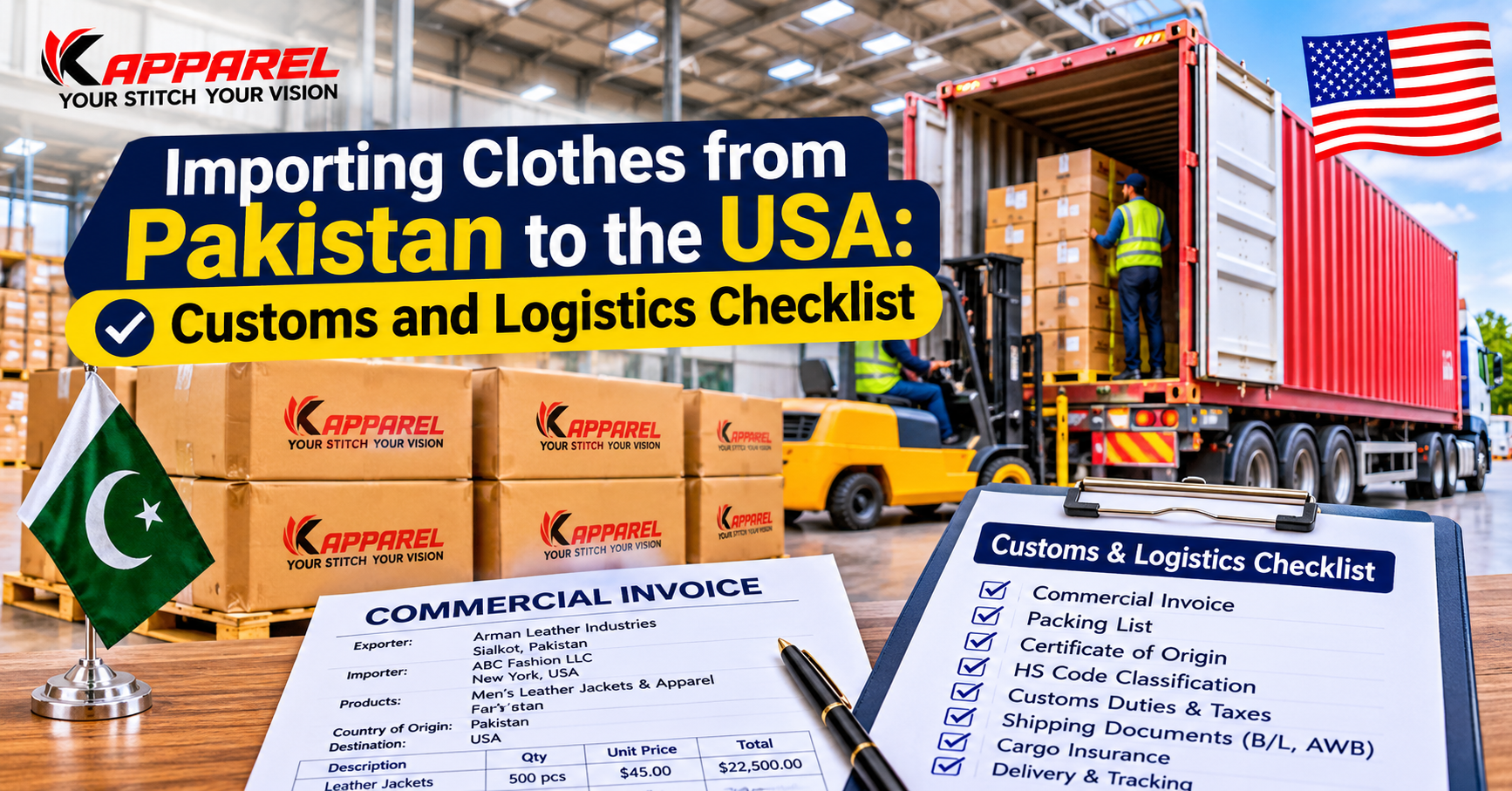
A Practical Guide to Importing Clothes from Pakistan to the USA
Importing clothes from Pakistan to the USA can be a smart move for a clothing brand, boutique, or online store. Pakistan has deep experience in knitwear, denim, fleece, activewear, and cut-and-sew production, and many US buyers work with Pakistani factories for quality and flexible order sizes.
The part that worries most first-time importers is not the factory. It is the paperwork. A wrong HS code, a mismatched commercial invoice, or a missing Bill of Lading detail can hold your cartons at a US port for days or weeks. This guide explains the documents, HS codes, duty basics, and steps you need for smooth US customs clearance. It also includes a short note for UK buyers.
One important point first. US tariff rules have changed often over the past two years. As of late November 2026, reporting shows that the United States applies a 10% Section 301 tariff to Pakistani imports (effective July 24, 2026) on top of the regular duty for your product. Rules and exemptions can change again, so confirm the latest rates with your customs broker before every order.
What Does Importing Clothes from Pakistan to the USA Involve?
When you import apparel into the USA, your goods are inspected, classified, valued, and taxed by US Customs and Border Protection (CBP). You, as the buyer, are normally the “importer of record.” That means you are legally responsible for the accuracy of every entry.
In simple terms, the process has four parts:
- The factory in Pakistan makes the goods and prepares the export documents.
- A freight forwarder moves the cartons by sea or air to a US port.
- A licensed US customs broker files the entry with CBP and handles the paperwork.
- You pay duties, taxes, and fees, then receive the goods at your warehouse or fulfillment center.
Most small and mid-size US brands use a customs broker and a freight forwarder instead of doing everything themselves. It is faster and reduces costly errors.
Why Customs Knowledge Matters for US Apparel Buyers
Clothing is one of the most closely watched import categories in the USA. Duty rates on apparel are often higher than on many other goods, and CBP checks fiber content, labeling, and country of origin carefully.
Good preparation protects your margins. Duty is calculated on the declared value of your goods, so a landed cost estimate that ignores tariffs can wipe out your profit on a low-priced item. It also protects your timeline. A clean, accurate file usually moves faster than one with questions attached.
| Area | What Can Go Wrong | What It Costs You |
|---|---|---|
| Wrong HS Code | Incorrect duty, possible penalties | Higher duty or fines |
| Invoice Mismatch | CBP questions or exam | Delays and storage fees |
| Missing Labels | Goods may be held or relabeled | Extra labor and time |
| No Customs Bond | Entry cannot be filed | Shipment stuck at port |
| Weak Supply Chain Records | Detention for review | Weeks of delay |
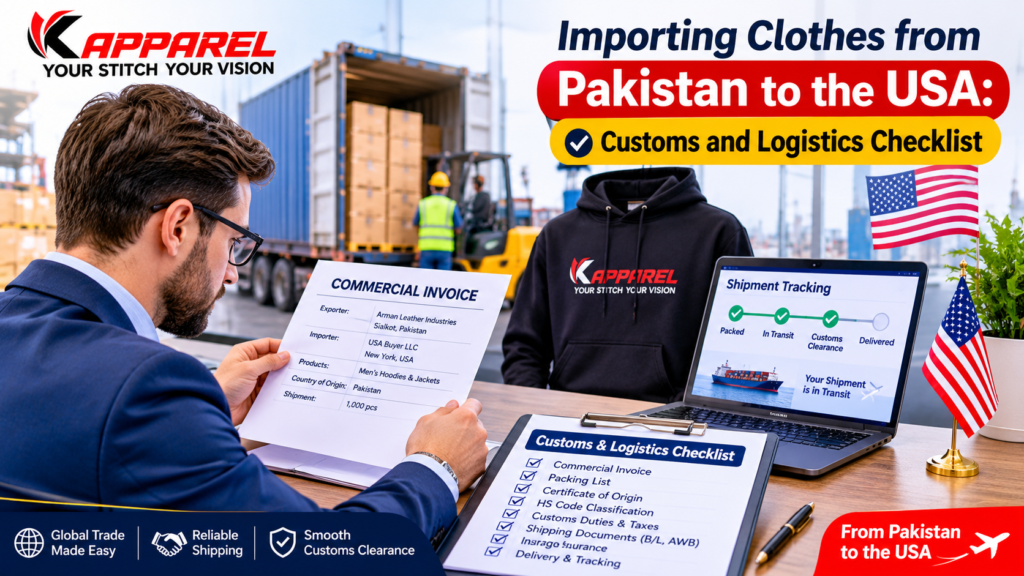
Key Documents You Need to Import Clothing into the USA
Having the right documents ready before the shipment leaves Pakistan is the single best way to avoid trouble. Here are the core ones.
Commercial Invoice
The commercial invoice is the main document CBP uses to check value and description. It should come from the factory and match your purchase order exactly. A strong invoice includes:
- Full names and addresses of seller and buyer
- Invoice number and date
- Clear product description (for example, “men’s 100% cotton knitted pullover hoodies,” not just “garments”)
- Fiber content, quantity, unit price, and total value
- Country of origin (Pakistan)
- Incoterms, such as FOB or DDP, and payment terms
- HS code for each product line
Vague descriptions are a common reason for CBP questions. Be specific.
Bill of Lading
The Bill of Lading (B/L) is issued by the shipping line or carrier. It acts as a receipt for the cargo, a contract of carriage, and often a document of title. For ocean freight it is called an Ocean Bill of Lading. For air freight it is an Air Waybill (AWB).
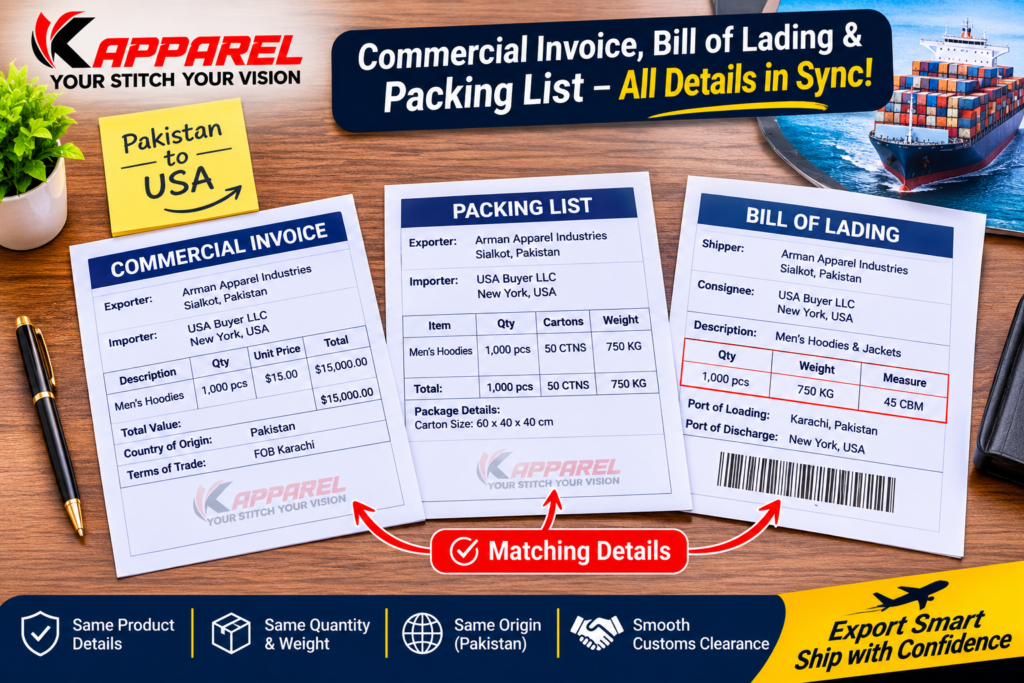
Check that the shipper, consignee, notify party, container number, carton count, and weight all match the invoice and packing list. Even small differences can create delays.
Packing List
The packing list shows how the goods are packed: carton counts, sizes per carton, gross and net weights, and carton dimensions. Customs officers and warehouse teams use it to check what arrived.
Other Documents and Filings
| Document or Filing | Purpose | Who Usually Handles It |
|---|---|---|
| Customs Bond | Guarantees payment of duties to CBP | Importer, through a surety |
| ISF (Importer Security Filing) | Required for ocean shipments, filed before loading | Importer or customs broker |
| CBP Entry Forms (3461 and 7501) | Formal entry and entry summary | Customs broker |
| Power of Attorney | Lets your broker file on your behalf | Importer |
| Certificate of Origin | Supports origin claims when requested | Factory or chamber |
| Manufacturer ID (MID) | Identifies the manufacturer on textile entries | Customs broker, using factory details |
If you ship by ocean, remember that the ISF filing must be submitted at least 24 hours before the cargo is loaded onto the vessel. Late filing can lead to penalties.
Understanding HS Codes and HTS Classification for Clothing
HS codes (Harmonized System codes) are international numbers that classify products. When goods enter the USA, they are classified under the Harmonized Tariff Schedule of the United States (HTSUS), which expands the HS code to 10 digits. The code decides your base duty rate and some reporting rules.
| Chapter | Clothing Type | Examples |
|---|---|---|
| Chapter 61 | Knitted or Crocheted Apparel | T-shirts, hoodies, sweatshirts, leggings, jerseys |
| Chapter 62 | Woven Apparel | Jackets, cargo pants, denim, shirts |
| Chapter 65 | Headwear | Caps, beanies |
| Product | Typical HS Heading |
|---|---|
| Knitted T-shirts and Tank Tops | 6109 |
| Knitted Sweatshirts, Hoodies and Pullovers | 6110 |
| Knitted Tracksuits | 6112 |
These are headings only. The full 10-digit code, and the duty rate, depend on fiber (cotton, polyester, blends), gender, construction, and sometimes the number of stitches or pieces. A hoodie with a woven panel or a lined jacket may classify differently from a plain one.
Two simple rules help:
- Ask your factory for its suggested HS code, then have your US customs broker confirm it.
- Keep fabric composition and construction details on file, so you can support the code if CBP asks.
How Custom Duties Work for Clothing Imported into the USA
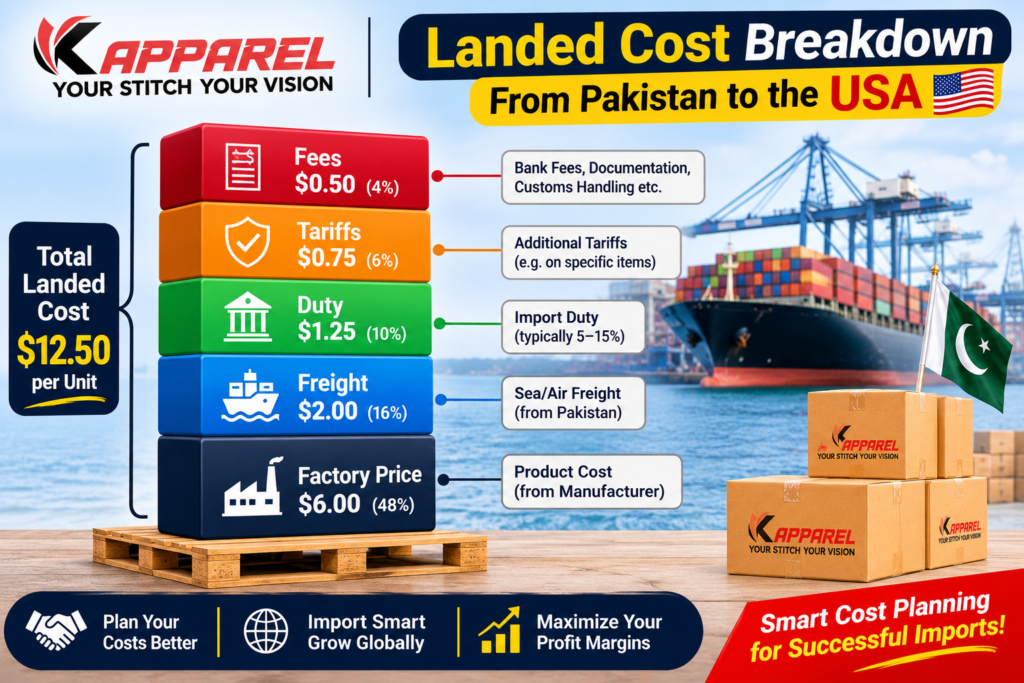
Your total landed cost has several layers. In general, a US apparel import can face:
| Cost Layer | What It Is |
|---|---|
| Base Duty | The standard HTSUS rate for your product’s code |
| Additional Tariffs | Extra measures that apply to the country of origin, such as applicable additional tariffs |
| Merchandise Processing Fee (MPF) | A CBP processing fee based on merchandise value, subject to minimum and maximum limits |
| Harbor Maintenance Fee (HMF) | A fee on applicable ocean cargo |
| Freight and Insurance | Shipping and insurance costs, which depend on your Incoterms |
| Broker and Bond Fees | Costs for customs filing services and the customs bond |
Here is a simple way to think about it. Say your declared goods value is X. Your duty is the HTSUS rate multiplied by X, plus any applicable additional tariff percentage multiplied by X. Then add the relevant customs fees and shipping costs.
Ask your customs broker to calculate these costs for each clothing style before you place a bulk order. This helps you estimate your total landed cost and avoid unexpected expenses.
Because trade policy has shifted since the US Supreme Court struck down the earlier “reciprocal” duties in February 2026, and trade specialists expect continued tariff pressure on imported apparel, build a safety margin into your pricing. Also ask your factory about whether any textile-related relief programs could apply to your products. Details have been proposed but should be verified before you count on them.
Step-by-Step Logistics Checklist for US Customs Clearance
Use this checklist from order to delivery.
Before You Order
- Confirm your product’s HS code with a customs broker.
- Ask for a landed cost estimate that includes duty and current tariffs.
- Agree on Incoterms with the factory (FOB, CIF, or DDP).
- Check that labels meet US rules: fiber content, country of origin, manufacturer or importer identity (RN or company name), and care instructions.
- Set up your customs bond and sign a power of attorney with your broker.
During Production
- Approve samples, trims, and packaging before bulk production starts.
- Ask the factory to keep records of fabric sources and production steps.
- Confirm carton markings and packing method so they match your warehouse needs.
Before Shipping
- Review the draft commercial invoice and packing list for accuracy.
- Make sure your broker files the ISF at least 24 hours before ocean loading.
- Confirm the Bill of Lading details with your forwarder before it is finalized.
At the US Port
- Your broker submits the entry and pays duties and fees.
- CBP may release the cargo, ask for more information, or select it for exam.
- Arrange trucking or pick-up once the goods are released.
After Delivery
- Keep all import records organized. US importers generally need to retain entry records for several years, so ask your broker how long to keep them.
- Check the finished goods against your purchase order and report any issues quickly.
Common Mistakes When Importing Clothes from Pakistan to USA
Using general product descriptions. “Garments” or “apparel” tells CBP almost nothing. Be specific about fiber, gender, and style.
Guessing the HS code. A wrong code can lead to underpaid duty and penalties. Let a broker verify it.
Undervaluing goods. Declaring a lower value to reduce duty is illegal and creates serious risk. Always declare the true transaction value.
Ignoring labeling rules. US apparel needs proper fiber content, country of origin, and care labeling. Missing labels can lead to holds or relabeling costs.
Skipping supply chain records. US authorities pay close attention to forced-labor concerns, and cotton goods can face questions about where materials came from. Keep supplier details and traceability records ready.
Choosing the cheapest freight without checking transit and port details. A low quote can hide extra charges at destination.
Not planning for tariff changes. Pricing that ignores policy risk can leave you with a loss if rates rise after you place the order.
Best Practices for Smooth Customs Clearance in the USA
- Work with an experienced factory. A Pakistani manufacturer that regularly ships to the USA already understands invoices, labels, and packing standards. For example, a custom apparel manufacturer like IKapparel supports US brands with private label clothing, labels and tags, and export-ready packing, which reduces back-and-forth on documents.
- Use a licensed customs broker. They can confirm classification, file the entry, and answer CBP questions quickly.
- Keep documents consistent. Names, quantities, values, and descriptions should match across every document.
- Ship in a planned schedule. Avoid last-minute orders so you are not forced into expensive air freight.
- Order samples first. A small test shipment helps you learn the process before a large order.
- Track policy updates. Check US trade news and your broker’s alerts regularly.
If you are building your own brand, it helps to line up products and branding early. You can explore Private Label Clothing and Custom Labels & Tags so your labels meet US requirements from the start. If fabric weight and quality are important for your product, Fabric Sourcing & GSM Customization is useful to review before production. Brands comparing decoration options can read about Types of Branding.
How to Choose the Right Supplier and Logistics Partner
Pick partners the same way you would pick a long-term business partner. Look for:
| Factor | What to Ask |
|---|---|
| Export Experience | Has the factory shipped to the USA before? Can it share its process? |
| Document Accuracy | Does it prepare invoices and packing lists with full descriptions and HS codes? |
| Labeling Support | Can it sew in US-compliant labels and tags? |
| Communication | Does the team reply clearly and on time? |
| Order Flexibility | What are the minimum order quantities and sampling options? |
| Quality Control | How are measurements, stitching, and fabric checked before shipping? |
| Logistics Support | Can the team coordinate with your freight forwarder and customs broker? |
For ready-to-brand products, many US startups begin with Blanks and add their own branding, which keeps early orders simple.
A Quick Note for UK Buyers
If you import into the UK instead, the process is similar but the rules differ. You need an EORI number, a commodity code, a commercial invoice, and transport documents. Pakistan is part of the UK’s Developing Countries Trading Scheme (DCTS), which offers reduced or zero duty on many goods, including a large share of clothing. To benefit, your goods must meet the origin rules, and the UK updated its garment origin rules from January 1, 2026. Import VAT still applies. Check the official UK tariff tool and confirm origin proof with your supplier before shipping.
Frequently Asked Questions About Importing Clothes from Pakistan to the USA
Do I need a license to import clothes into the USA?
You do not usually need a special license for general apparel, but you must have a customs bond and file entries correctly as the importer of record. Some goods, such as certain textiles covered by quota or special rules, may need extra steps, so ask your customs broker.
What is the HS code for clothing imported from Pakistan?
There is no single code. Knitted T-shirts usually fall under heading 6109, knitted hoodies under 6110, and woven trousers under 6203. The full 10-digit HTSUS code depends on fiber, gender, and construction.
How much duty will I pay on apparel from Pakistan?
It depends on your product’s HTSUS rate plus any additional tariffs in effect for Pakistan, along with small customs fees. In 2026, a 10% Section 301 tariff has been reported on Pakistani imports. Always confirm the current figure with a broker.
What is the difference between a Bill of Lading and a commercial invoice?
The commercial invoice shows what was sold, to whom, and at what value. The Bill of Lading is the carrier’s document that proves the goods were shipped and sets out the transport terms. Customs reviews both, so details must match.
How long does clearance take in the USA?
Many clean shipments clear within a few days, but exams, missing documents, or holds can add time. Accurate paperwork is the best way to avoid delays.
Final Thoughts
Importing clothes from Pakistan to the USA is very doable when you prepare in the right order. Get your HS codes confirmed, keep your commercial invoice and Bill of Lading accurate, set up your bond and ISF, and price in current duties and tariffs. A reliable factory and a good customs broker will save you both time and money.
If you are planning a US-bound order, IKapparel can help you with private label production, custom labels, and export-ready apparel. Contact the team with your product list and target quantities to start the conversation.
Disclaimer: This article is for general information and is not legal or customs advice. Duty rates and trade rules change, so confirm details with a licensed US customs broker or official government sources before shipping.