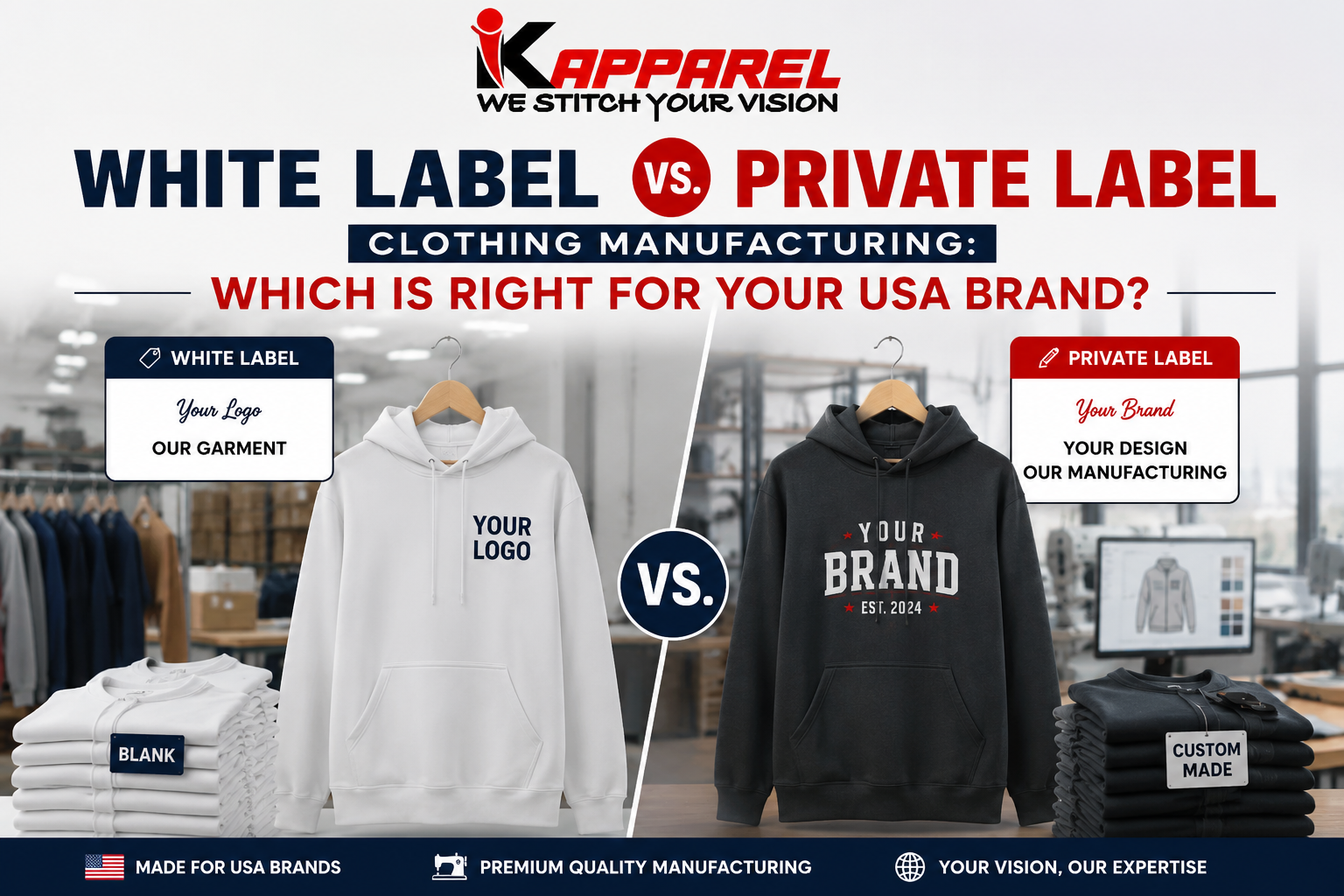
Starting a clothing brand in the USA today means making one big decision early on: do you go with white label clothing, or do you build a private label clothing line from scratch? Both paths can get your designs into customers’ hands, but they work in very different ways, and picking the wrong one can slow your business down or eat into your budget.
If you are a small business owner, an Etsy or Shopify seller, a streetwear founder, or a growing team apparel brand in the United States, this guide breaks down exactly how white label and private label manufacturing differ. We will cover customization, cost, time-to-market, and branding depth, so you can decide which model fits your goals, your budget, and your timeline.
WHAT IS WHITE LABEL CLOTHING MANUFACTURING?
White label clothing manufacturing means a factory produces a generic, ready-made garment, and multiple brands buy that same product and add their own logo or design on top. Think of it as buying a blank canvas that already has a finished shape, fit, and fabric, then customizing the surface with printing, embroidery, or a woven label.
This is common with items like blank hoodies, blank t-shirts, blank joggers, and other basics where the garment construction itself does not need to change. A US-based brand can order these blanks, apply screen printing or embroidery, and sell them as their own product, even though other brands may be selling the exact same base garment.
WHAT IS PRIVATE LABEL CLOTHING MANUFACTURING?
Private label clothing manufacturing goes a step further. Instead of using an existing generic garment, the brand works with a manufacturer to build a product from the ground up, often with input on fabric, fit, weight, trims, and construction. The final garment is made specifically for that brand and is not sold to anyone else under a different name.
This route is popular with USA fashion startups and established apparel companies that want a truly original product line, not just a printed design on a common blank. Private label often includes custom labels and tags, custom packaging, and sometimes proprietary fabric sourcing, which helps the final piece feel unique rather than mass-produced.
WHY THIS DECISION MATTERS FOR USA BUSINESSES
The US apparel Strategy is competitive, and customers are used to seeing the same blank tee or hoodie printed by dozens of different small brands. Choosing between white label and private label affects how your brand is perceived, how fast you can launch, and how much capital you need upfront.
For a new US brand testing the market, white label can mean a faster, lower-risk launch. For a brand ready to build long-term identity and differentiate from competitors selling similar printed products, private label can create a stronger, more defensible position. Neither option is automatically “better.” The right choice depends on your stage of growth, budget, and long-term vision for the brand.
KEY DIFFERENCES AT A GLANCE
Here is a side-by-side comparison to help you quickly see how the two models compare across the factors that matter most to USA sellers and brand owners.
| Factor | White Label | Private Label |
|---|---|---|
| Customization | Logo, print, or embroidery on an existing blank garment | Fabric, fit, construction, trims, and full design |
| Manufacturing Cost | Lower upfront cost, since the base product already exists | Higher upfront cost due to pattern making, sampling, and custom sourcing |
| Time-to-Market | Fast, often days to a few weeks | Longer, often several weeks to a few months |
| Minimum Order Quantity | Usually lower, flexible for small or growing brands | Usually higher, since production is custom |
| Branding Depth | Surface-level branding (logo, print, tag) | Deep, product-level branding with full ownership of design |
| Product Uniqueness | Limited, since other brands may use the same blank | High, since the product is made only for your brand |
| Best For | New brands, testing designs, seasonal drops, small teams | Established brands, USA fashion labels scaling up |
KEY BENEFITS OF WHITE LABEL CLOTHING
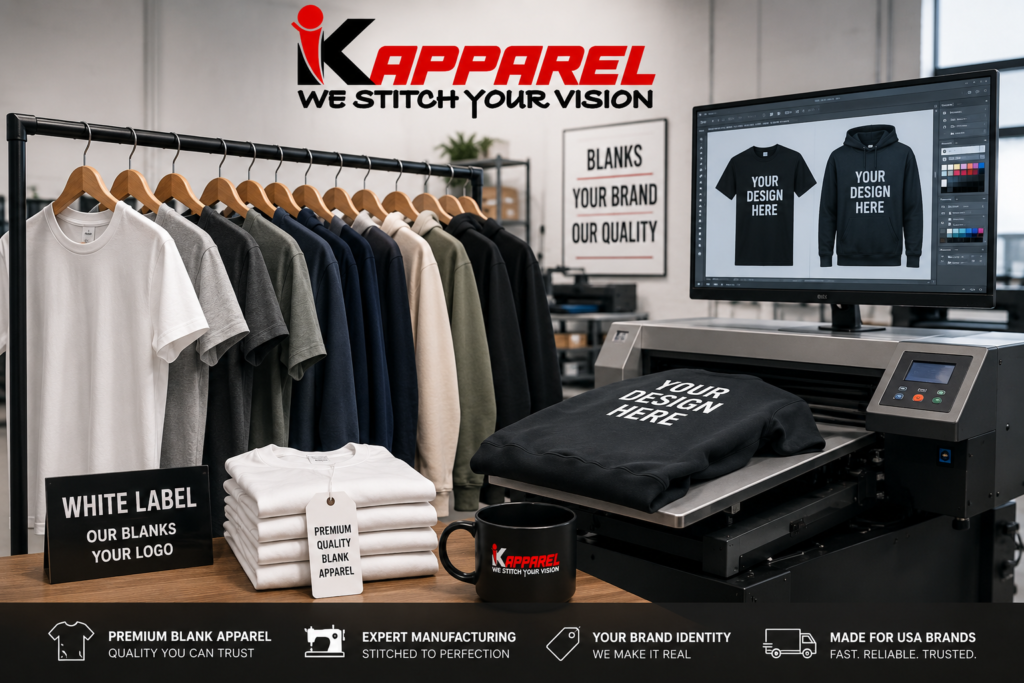
White label manufacturing gives new and growing USA brands a practical way to enter the market without heavy upfront investment. Because the base garment already exists in proven styles and sizes, there is no need to pay for pattern development or fit testing. This lowers financial risk and speeds up the entire process from order to delivery.
It also gives smaller businesses access to techniques like screen printing, embroidery, DTG printing, and custom patches, without needing a large minimum order. This makes it easier to test different designs, colors, and product types before committing to a full private label investment.
KEY BENEFITS OF PRIVATE LABEL CLOTHING
Private label manufacturing gives a USA brand full control over how a product looks, feels, and fits. Because the garment is built specifically for that brand, there is no risk of a competitor selling the exact same base product. This is a major advantage for brands trying to build long-term recognition and loyalty in a crowded US market.
Private label also allows more detailed decisions around fabric weight, garment construction, and finishing, along with custom labels, tags, and packaging. For brands planning wholesale distribution, retail partnerships, or a premium price point, this level of control often supports a stronger, more consistent brand identity over time.
White Label vs Private Label Clothing Manufacturing
White Label Process
A brand selects a pre-made blank garment from a supplier’s catalog, chooses size and color options, then applies branding through printing or embroidery. Once approved, the order goes into production and ships out, usually within a short turnaround window.
Private Label Process
A brand works with a manufacturer starting from concept and design, moving through fabric sourcing, sample development, fit approval, and then bulk production. Custom labels, tags, and packaging are usually added at this stage as well, since the entire product is being built around that brand from day one.
IMPORTANT FACTORS FOR USA BRANDS TO CONSIDER
Budget and Cash Flow
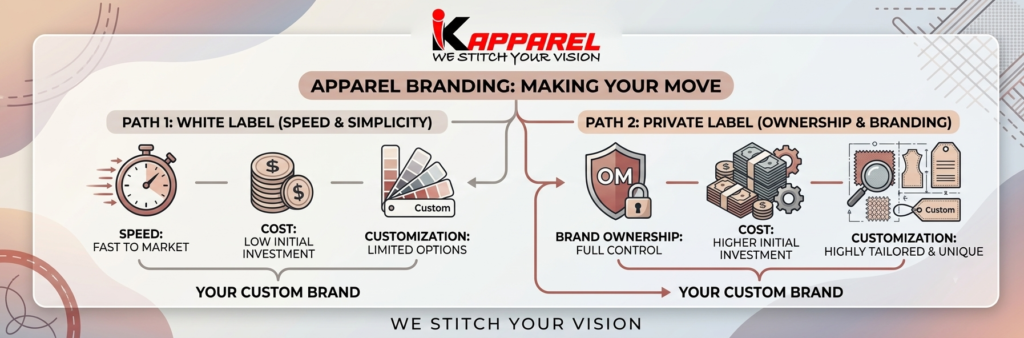
White label generally requires less capital upfront, which matters for small US businesses managing tight cash flow. Private label requires a bigger investment but can offer stronger margins once the brand is established.
Timeline and Launch Goals
If you are trying to launch quickly for a seasonal drop, holiday collection, or a US-based pop-up event, white label is usually faster. If you are building toward a long-term retail or wholesale strategy, private label’s longer timeline is often worth it.
Brand Differentiation
Ask whether your customers care about a unique fabric, fit, or construction, or whether a strong design and logo on a well-made blank is enough. USA streetwear and team apparel brands, for example, often start with white label and move to private label once demand is proven.
Order Volume
White label suppliers typically allow smaller minimum order quantities, which works well for new brands. Private label often requires higher minimums, since custom production runs are less efficient at small scale.
COMMON MISTAKES TO AVOID
One common mistake is choosing private label too early, before a brand has proven demand, which can tie up cash in inventory that has not been tested with real customers. Another is staying with white label too long once a brand has strong repeat sales, missing the chance to build a more defensible product.
Many USA sellers also underestimate lead times. Private label production, including sampling and fabric sourcing, takes longer than expected, so planning launches around holidays or peak seasons without buffer time can cause delays. Skipping quality checks on fabric, stitching, or print durability is another mistake that leads to returns and unhappy customers.
Finally, some brands choose a manufacturer based on price alone, without checking their experience with customization methods like embroidery, DTF printing, or custom rhinestones, which affects how the final product actually looks and holds up over time.
BEST PRACTICES FOR USA CLOTHING BRANDS
Start with a clear plan for how much customization your brand actually needs. If a great logo and clean print on a quality blank hoodie will satisfy your customers, white label may be the smarter first step. If your brand story depends on a specific fabric feel, cut, or construction detail, private label is worth the extra investment.
Work with a manufacturer that offers both options, so you can start with white label and transition into private label as your brand grows, without switching suppliers or restarting relationships. Always request samples before a bulk order, check fabric weight (GSM), and confirm turnaround times in writing, especially around busy US shopping seasons like back-to-school and the holiday period.
HOW TO CHOOSE THE RIGHT OPTION FOR YOUR BRAND
Start by being honest about your current stage. A brand new to the US market with a limited budget usually benefits more from white label, since it reduces financial risk while still allowing a professional, branded product. A brand with proven sales, a growing customer base, and a bigger budget is often ready for the deeper commitment of private label.
Also consider your manufacturing partner’s range of services. A supplier that offers screen printing, embroidery, custom patches, and private label clothing production under one roof makes it easier to grow from one model into the other without disruption. Brands working with a full-service partner like IKapparel, a manufacturer trusted by clothing brands across the United States and around the world, can move between white label and private label as their business scales, without needing to rebuild supplier relationships from scratch.
FREQUENTLY ASKED QUESTIONS ABOUT WHITE LABEL VS. PRIVATE LABEL CLOTHING
What is the main difference between white label and private label clothing?
White label uses an existing blank garment that is customized with a logo or print, while private label builds a garment specifically for one brand, often with custom fabric, fit, and construction from the start.
Is white label clothing cheaper than private label for a USA startup?
Yes, white label is usually cheaper upfront because the base garment already exists. Private label requires more investment in sampling, fabric sourcing, and development before production begins.
How long does private label clothing manufacturing take?
Private label timelines vary, but they generally take longer than white label because of sampling, fit approval, and custom fabric sourcing. Brands should plan for several weeks to a few months depending on complexity.
Can a small USA business start with white label and later switch to private label?
Yes, this is a common and practical path. Many US brands start with white label to test designs and demand, then move into private label once sales are consistent and they are ready for a fully custom product.
Which option is better for USA team or league apparel?
Team and league apparel often works well with white label or semi-custom production, since teams need fast turnaround, consistent sizing, and clear branding without the longer development time private label requires.
FINAL THOUGHTS
Choosing between white label and private label clothing manufacturing comes down to where your USA brand is right now, and where you want it to go. White label offers a faster, lower-cost way to launch and test your designs in the market. Private label offers deeper control over your product, which can strengthen your brand’s identity as you grow.
There is no universal right answer, only the right answer for your current stage, budget, and goals. Whichever path fits your business today, working with an experienced manufacturing partner makes the process smoother and helps your brand look and feel professional from day one.
Dear IK Apparel Team,
My name is Dr. Malisa A. Blackwell, and I am the Founder and CEO of UNITYONE™, a premium Christian lifestyle apparel brand based in the United States.
I am currently searching for a reliable manufacturing partner to support the growth of my brand. After learning about IK Apparel, I am interested in exploring the possibility of building a long-term business relationship with your company.
To evaluate the quality of your products and craftsmanship, I would like to order samples of the following:
* Premium heavyweight T-shirts (260–280 GSM, 100% combed ring-spun cotton)
* Premium cotton piqué polo shirts (220–240 GSM)
* Premium baseball caps with high-quality 3D puff embroidery
I am looking for luxury-quality apparel with private-label capabilities, including:
* Custom woven neck labels
* Custom hang tags
* High-quality embroidery
* Screen printing
* 3D puff embroidery
* Custom packaging
I would appreciate it if you could provide the following information:
* Sample pricing
* Minimum order quantities (MOQ)
* Production lead times
* Available fabric options and GSM weights
* Embroidery and printing capabilities
* Shipping options to the United States
My vision is to establish a long-term partnership with a manufacturer that shares a commitment to quality, consistency, and excellence. As UNITYONE™ grows, I hope to work with a trusted manufacturing partner capable of producing premium apparel that reflects our brand values.
I look forward to your response and the opportunity to work together.
Thank you for your time and consideration.
Sincerely,
**Dr. Malisa A. Blackwell**
Founder & CEO, UNITYONE™
*Breaking Barriers. Building Kingdom.*