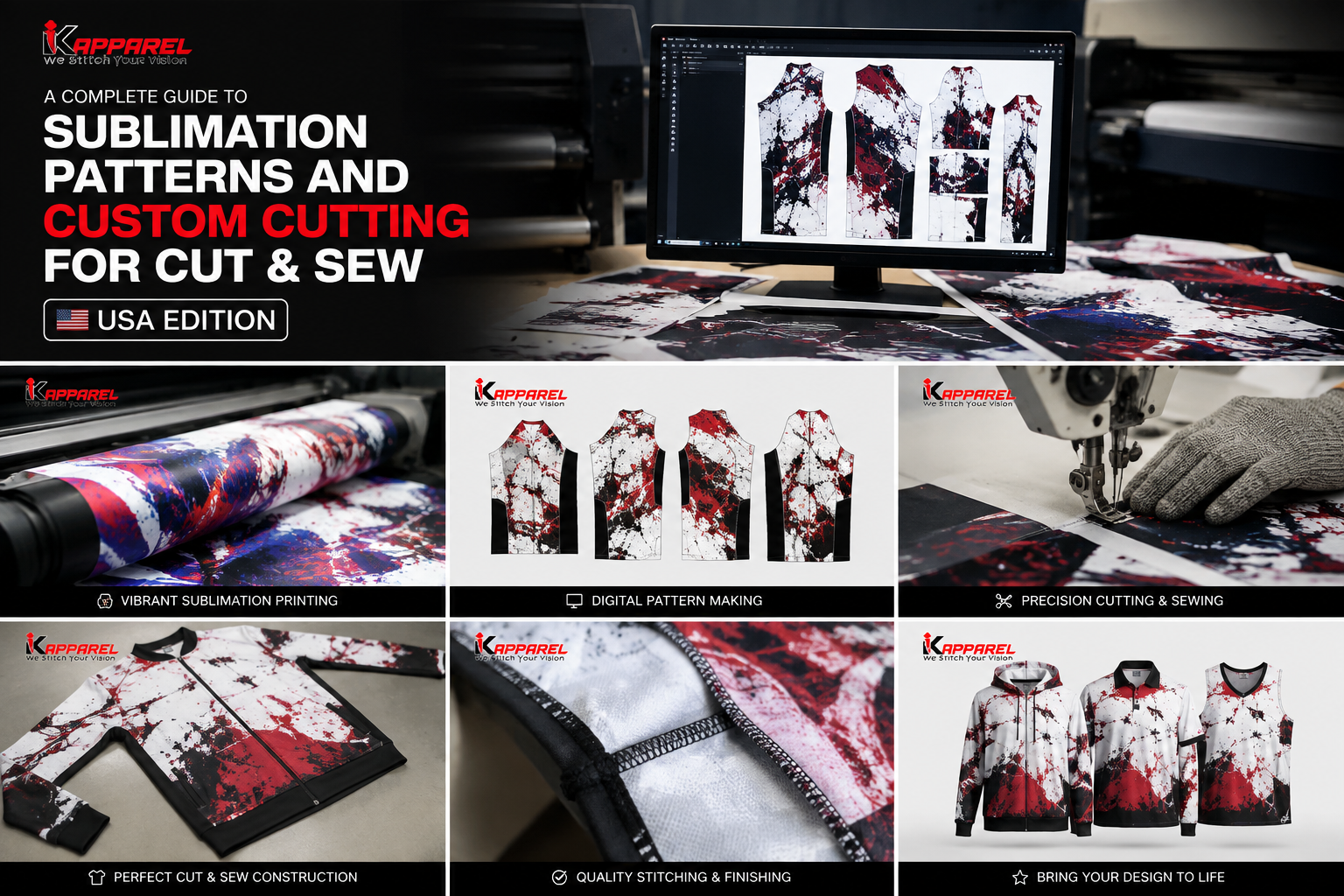
If you have ever unboxed a custom cut and sew order and noticed the printed design does not line up at the seams, you already understand why sublimation patterns and custom cutting matter so much. In the United States apparel market, brands are under constant pressure to deliver flawless, print-perfect garments, whether it’s a streetwear label in Los Angeles, a team uniform supplier in Texas, or a private label startup shipping out of New Jersey. Misaligned panels, shifted prints, and pattern distortion are some of the most common (and most avoidable) quality issues in custom apparel production.
This guide breaks down exactly how sublimation printing and custom pattern cutting work together, why precision cutting is the deciding factor between a professional-looking garment and a sloppy one, and how USA-based brands can avoid the most common mistakes when ordering cut and sew sublimation apparel.
WHAT IS SUBLIMATION CUT AND SEW?
Sublimation cut and sew is a manufacturing method where fabric panels are printed first using dye-sublimation, then cut into precise pattern pieces before being sewn into a finished garment. This is different from printing on a finished blank garment (like a t-shirt already sewn together). Instead, the print happens on flat fabric, and the pattern pieces are cut around the design afterward.
This method is widely used for jerseys, hoodies, leggings, tracksuits, and all-over print apparel because it allows full-color, edge-to-edge designs that would be impossible with standard screen printing or embroidery. The tradeoff is that it demands extremely accurate pattern cutting, because even a small shift in fabric placement can throw off the entire design once the garment is assembled.
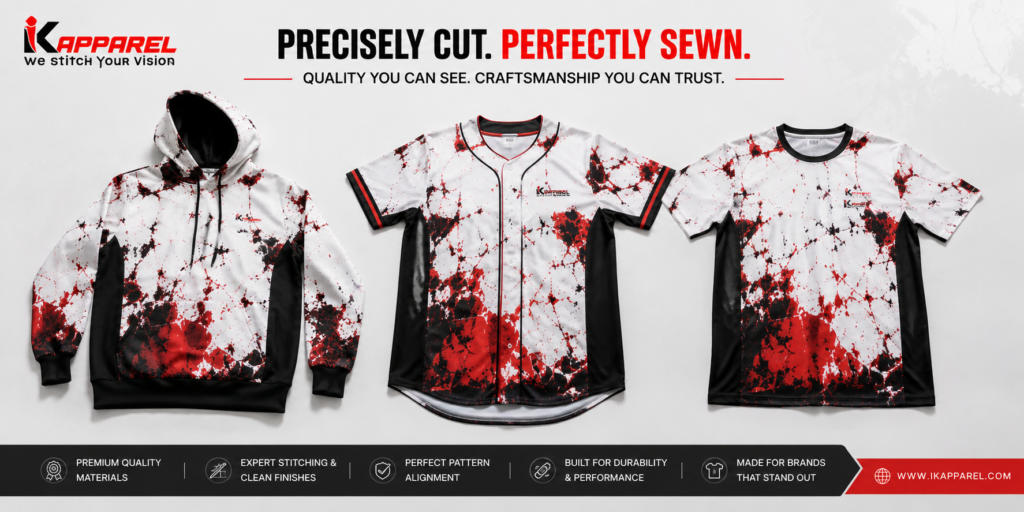
WHY SUBLIMATION PATTERN CUTTING MATTERS FOR USA BRANDS
For apparel brands selling in the USA, customers expect retail-level quality even from small custom orders. A shirt with a print that doesn’t match at the shoulder seam or a sleeve pattern that looks “off” compared to the body panel is an easy way to lose customer trust and increase return rates.
Precision pattern cutting matters because:
- It keeps the printed design consistent across every seam and panel.
- It reduces fabric waste, which directly affects production cost.
- It protects brand reputation, especially for teamwear, athleisure, and streetwear labels competing in a crowded USA market.
- It allows for repeatable, scalable production when a brand needs to reorder the same design in bulk.
Getting this right the first time is far more cost-effective than reprinting or re-cutting fabric after a batch comes out misaligned.
KEY BENEFITS OF PRECISION-MATCHED SUBLIMATION PATTERNS
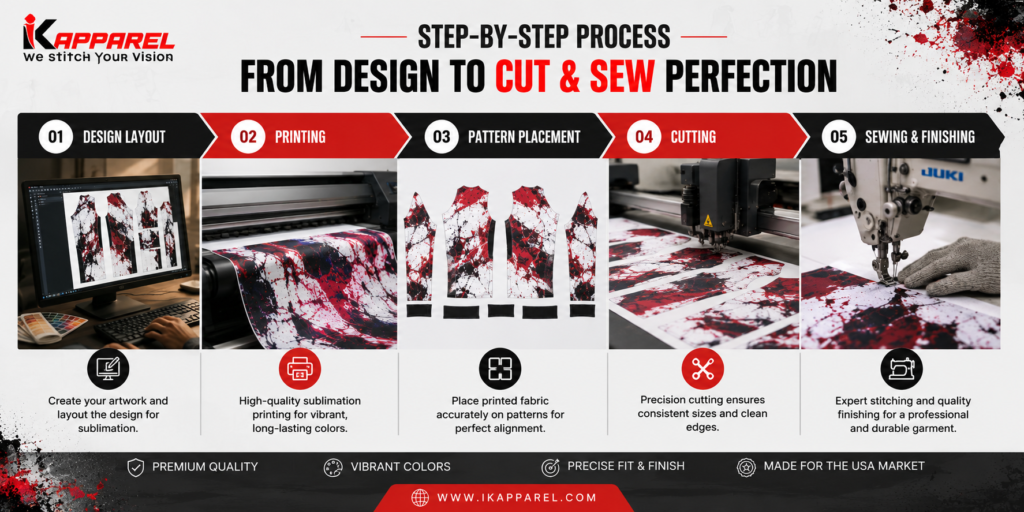
When sublimation printing and custom cutting are done correctly, brands see real, practical advantages. The print looks intentional rather than accidental, side seams and sleeve panels flow into each other smoothly, and the finished product photographs well for e-commerce listings, which matters a lot for USA-based online apparel sellers competing on Amazon, Shopify, and social commerce platforms.
Accurate pattern matching also improves fit consistency. Since the fabric is cut before sewing, a well-matched pattern ensures that sizing stays consistent across a full production run, which is especially important for teamwear and uniform programs where dozens or hundreds of matching garments are needed at once.
QUICK COMPARISON: STANDARD CUTTING VS. PRECISION PATTERN-MATCHED CUTTING
| Factor | Standard Cutting | Precision Pattern-Matched Cutting |
|---|---|---|
| Print alignment at seams | Often inconsistent | Consistent and intentional |
| Fabric waste | Higher, due to re-cuts | Lower, due to accurate placement |
| Best used for | Solid color or simple prints | All-over prints, jerseys, complex graphics |
| Production scalability | Harder to repeat exactly | Easy to repeat for bulk/team orders |
| Customer return risk | Higher | Lower |
HOW SUBLIMATION PATTERN CUTTING WORKS
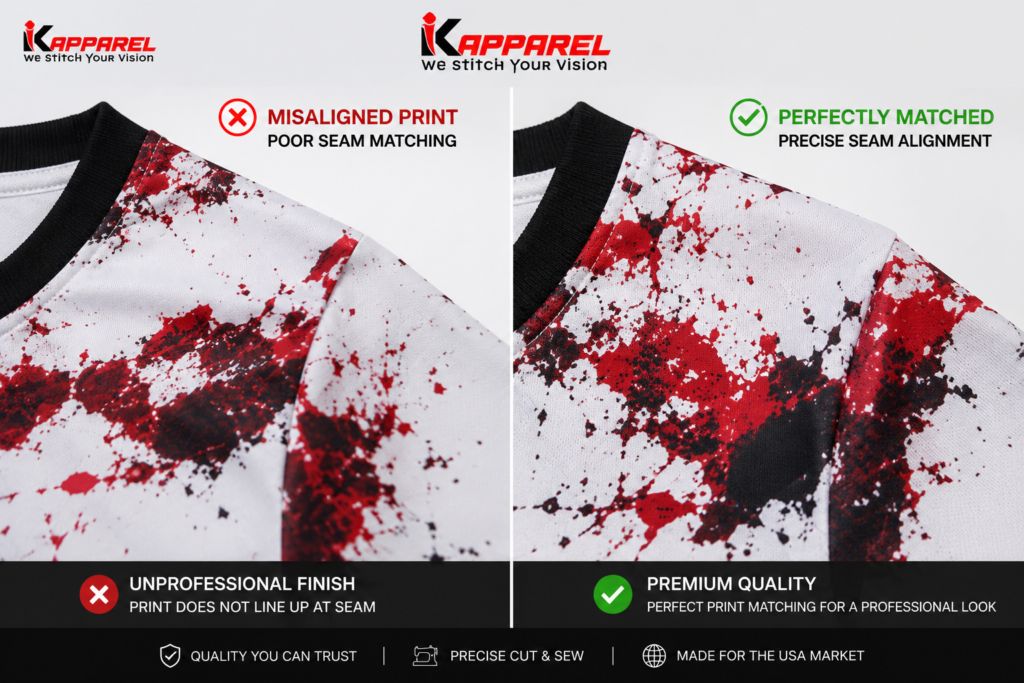
The process generally follows these steps:
- Design and layout: The artwork is arranged digitally so that it will align correctly once the fabric is cut into pattern pieces. This step, often called “pattern layout mapping,” is where alignment either succeeds or fails.
- Sublimation printing: The design is printed onto transfer paper, then heat-pressed onto polyester or poly-blend fabric so the dye becomes part of the fibers.
- Pattern placement: The printed fabric is laid out with the actual garment pattern pieces (front panel, back panel, sleeves, side panels) positioned exactly where the design needs to land.
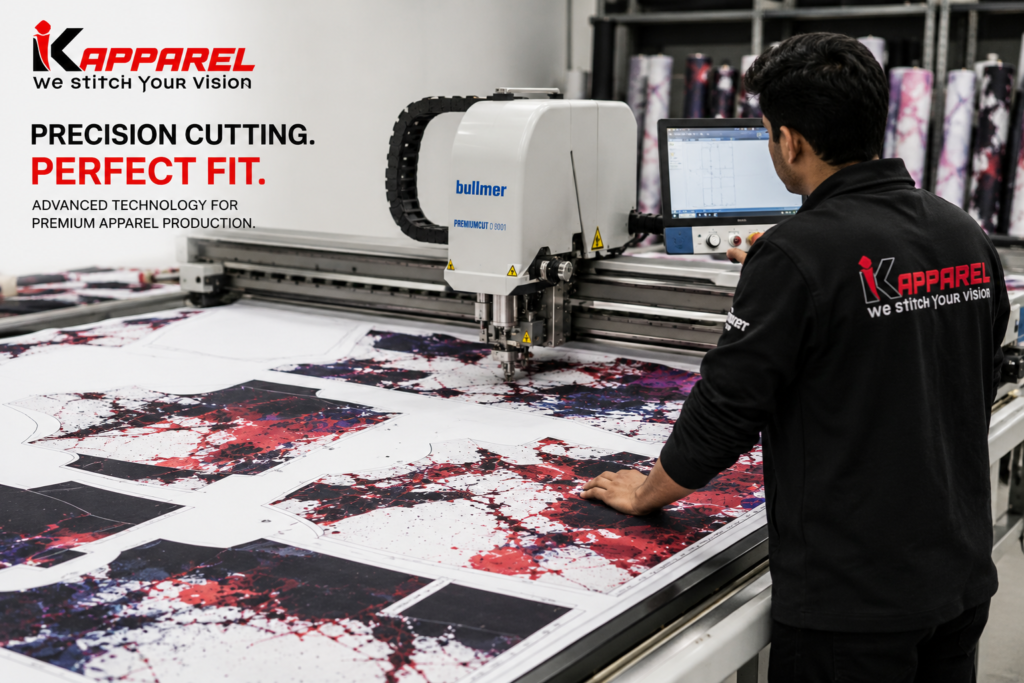
- Precision cutting: Using either computerized cutting machines or skilled manual cutting, the fabric is cut along the pattern lines so that each piece will match its neighboring piece once sewn.
- Sewing and assembly: The cut panels are sewn together, and if the earlier steps were done accurately, the print flows across seams without visible breaks or shifts.
Any error introduced in step 1 or step 3 becomes permanent once the fabric is cut, which is why experienced manufacturers spend extra time on layout accuracy before a single cut is made.
IMPORTANT FACTORS TO CONSIDER BEFORE PLACING A CUT AND SEW SUBLIMATION ORDER
Before working with any cut and sew manufacturer, USA-based brands should evaluate a few key factors:
Fabric type and GSM: Lighter fabrics behave differently under heat and pressure compared to heavier ones, which affects how accurately panels can be cut and matched.
Pattern complexity: Simple color blocks are more forgiving than intricate all-over graphics, so complexity should match the manufacturer’s actual capability.
Tolerance for shrinkage: Sublimation involves heat, and fabric can shrink slightly during the process. Manufacturers need to account for this in the pattern before cutting.
Sample approval: Always request a physical sample before a full production run, especially for a first-time design.
Production capacity: For teamwear or bulk private label orders, confirm the manufacturer can maintain consistent pattern accuracy across large quantities, not just on a single sample piece.
COMMON MISTAKES TO AVOID
| Mistake | Why It Happens | How to Avoid It |
|---|---|---|
| Printing before finalizing the pattern | Design and pattern are treated as separate steps | Lock the pattern first, then map the print to it |
| Ignoring fabric shrinkage | Heat press shrinkage is skipped in planning | Build a shrinkage allowance into the pattern |
| Rushing large production runs | Cutting speed prioritized over accuracy | Use checkpoints between print and cut stages |
| Skipping a pre-production sample | Trying to save time and cost | Always approve one physical sample first |
| Using the wrong fabric weight | Fabric not tested for the design type | Match fabric GSM to the garment’s intended use |
BEST PRACTICES FOR RELIABLE SUBLIMATION AND CUSTOM CUTTING RESULTS
Work with a manufacturer that treats pattern design and printing as one connected process, not two separate departments working from different files. Ask to see examples of past cut and sew sublimation work, specifically looking at how seams line up on finished garments, not just flat printed fabric. For teamwear or multi-size orders, request that pattern grading (the process of scaling a pattern up or down for different sizes) is tested across at least a small size range before committing to a full production run.
It also helps to build in a short buffer of extra fabric during cutting so that small misalignments can be corrected without stopping the entire production line.
HOW TO CHOOSE THE RIGHT MANUFACTURING PARTNER FOR SUBLIMATION CUT AND SEW
Choosing the right partner is the single biggest factor in getting consistent, professional results. USA brands should look for a manufacturer with proven experience in both sublimation printing and cut and sew construction, not just one or the other. Ask direct questions about their pattern-matching process, their sample approval workflow, and how they handle fabric shrinkage.
IKapparel is one example of a manufacturer that works across the full custom apparel production chain, including sublimation printing, cut and sew customization, fabric sourcing, and finishing. Brands evaluating a manufacturing partner should ask to see how a company like IKapparel or any similar full-service manufacturer handles pattern layout before printing, since this single step has the biggest impact on final alignment quality. If your brand needs a review of a design before it goes into full production, a design review and repair service is worth using as a safeguard against costly cutting errors.
For brands working on fabric selection specifically, understanding fabric sourcing and GSM customization options ahead of time makes the entire sublimation and cutting process smoother, since fabric weight directly affects how a printed pattern behaves once it’s cut and sewn.
WHY USA-BASED APPAREL BRANDS SHOULD CARE ABOUT THIS PROCESS
The USA custom apparel market, especially in categories like team sportswear, streetwear, and private label fashion, is highly competitive. Customers compare quality across brands constantly, and a print that doesn’t align at the seam is an easy, visible flaw that damages trust fast. Getting sublimation pattern cutting right is not just a manufacturing detail, it is a brand quality signal that customers notice immediately, whether they’re buying a custom hoodie, a team jersey, or an all-over print tee.
Brands sourcing cut and sew production, whether locally in the USA or through an experienced overseas manufacturing partner, should treat pattern-matching accuracy as a non-negotiable quality standard rather than an optional upgrade.
FREQUENTLY ASKED QUESTIONS ABOUT SUBLIMATION PATTERNS AND CUSTOM CUTTING
What is the difference between sublimation printing and cut and sew sublimation?
Standard sublimation printing is often applied to a finished garment or a simple flat item. Cut and sew sublimation prints the design onto flat fabric first, then cuts the pattern pieces from that printed fabric before sewing, which allows for full all-over prints across seams.
Why does my sublimation print not line up at the seams?
This usually happens when the pattern layout was not planned before printing, or when fabric shrinkage during the heat press step was not accounted for in the pattern. Both issues can be fixed by locking the pattern first and building in a shrinkage allowance.
Is sublimation cut and sew good for small custom orders?
Yes, but pattern-matching accuracy matters even more on small runs since there is less room to absorb errors across multiple pieces. A pre-production sample is strongly recommended for small orders.
What fabric works best for sublimation cut and sew?
Polyester and poly-blend fabrics generally work best because sublimation dye bonds most effectively with polyester fibers. Fabric GSM should match the intended garment type, lighter weights for tees and jerseys, heavier weights for hoodies and outerwear.
How do manufacturers keep patterns consistent across large team or bulk orders?
Reliable manufacturers grade and test the pattern across a size range before full production, and they run quality checkpoints between the printing stage and the cutting stage to catch alignment issues early.
FINAL THOUGHTS
Sublimation patterns and custom cutting work best when they are treated as one connected process instead of two separate steps. For USA-based apparel brands, getting this right protects both product quality and brand reputation, especially in competitive categories like teamwear, streetwear, and private label fashion. Whether you’re producing a small custom run or a large bulk teamwear order, prioritizing pattern accuracy before printing, testing for fabric shrinkage, and approving a physical sample first will save time, reduce waste, and result in a finished product that looks intentional and professional at every seam.